
Couldn't find the exact size or configuration?
Holloway Houston builds custom slings in-house to your exact specs - any length, WLL, and end fitting combination, with proof testing and cert documentation.
Holloway Houston manufactures alloy chain slings in Grade 80 and Grade 100, single-leg through four-leg configurations, with Working Load Limits from 1 ton through over 100 tons per sling assembly. Our chain slings are manufactured in Houston at one of the largest single-location sling shops in the country and tested on our own load-verification beds before shipment. Every sling ships with its ID tag, WLL markings, and manufacturer identification.
Holloway Houston builds custom slings in-house to your exact specs - any length, WLL, and end fitting combination, with proof testing and cert documentation.
When the job involves heat, abrasion, outdoor storage, or a load that would cut through synthetic slings, alloy chain is the go-to material. Chain slings go back on the hook after shifts in steel mills, foundries, shipyards, and fabrication shops that would destroy fiber or wire rope alternatives in short order. Holloway Houston manufactures chain slings - not a reseller pulling product from a distributor catalog. Single - leg through four-leg configurations, Grade 80 through Grade 100 alloy, with the end fittings the job calls for.
Chain slings are assembled in four standard leg configurations. The leg count determines how the load is distributed across the assembly and what load geometries the sling can address.
A single-leg sling connects one master link at the crane hook end to one end fitting at the load. The vertical hitch is the primary application - load hangs directly below the hook. The single-leg configuration is the workhorse for straight, symmetrical lifts where one attachment point on the load is sufficient. Browse Single Leg Chain Slings.
Two legs from a single master link spread to two separate attachment points on the load. This configuration handles wide or irregularly shaped loads that need two pick points to stay level. A two-leg bridle sling can also increase the total WLL compared to a single-leg, depending on the angle of the legs - individual product pages carry the configuration-specific WLL data. Browse Double Leg Chain Slings.
Three-leg slings distribute the load across three attachment points and are common on machinery lifts, motor pulls, and equipment with three lift lugs. The added leg count increases stability for loads that tend to shift or rotate during the pick.
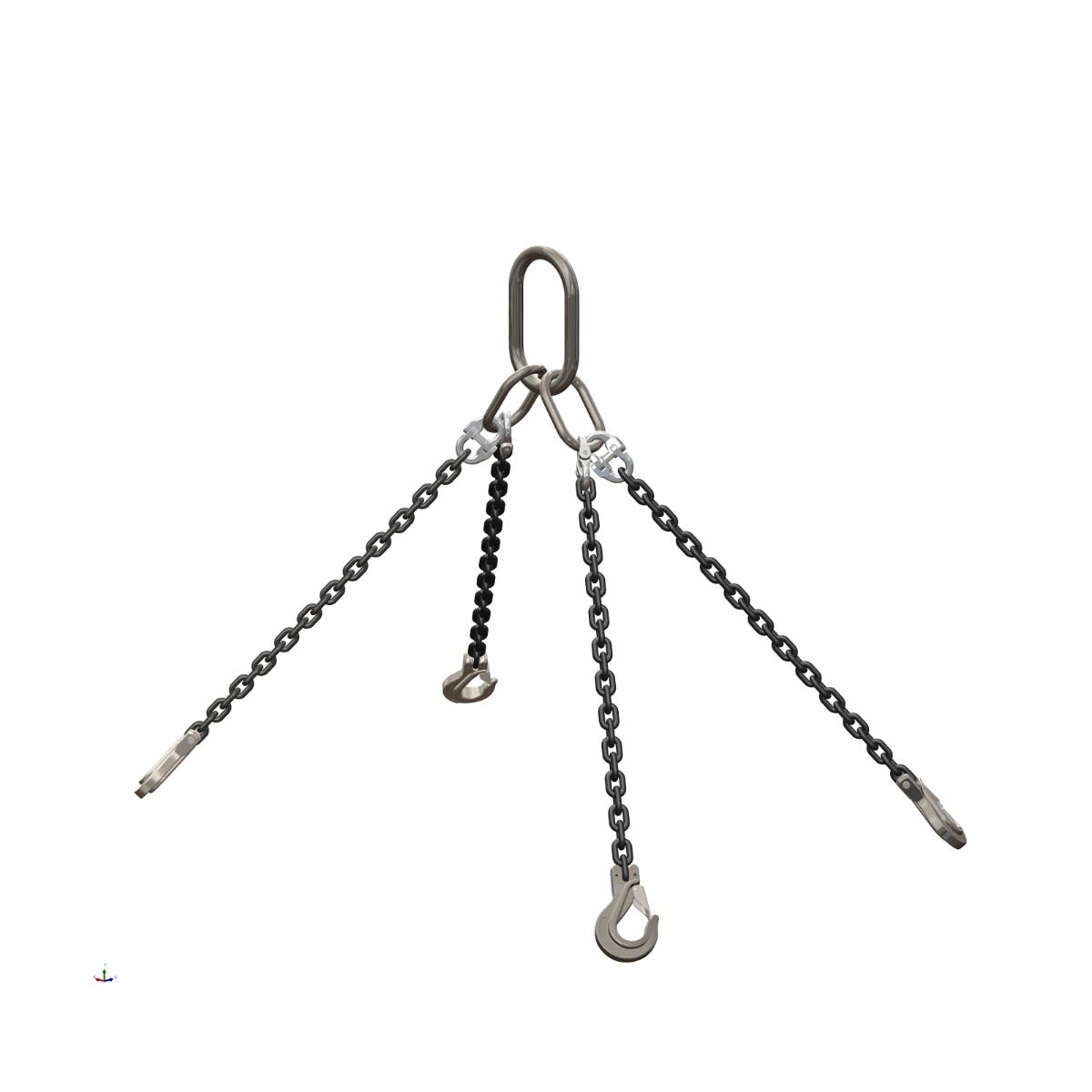
Four-leg slings address structural steel lifts, heavy fabrications, and large equipment where maximum stability and four attachment points are needed. Four-leg assemblies are common in steel mill and heavy manufacturing environments where the load has four lift points and the rigger needs the sling to hold the piece plumb throughout the pick. Browse Quad Leg Chain Slings.
Alloy chain slings are classified by grade - a designation that reflects the mechanical properties of the chain itself. Grade designations run on the product and on the sling assembly's identification tag. The three grades in common use for alloy chain slings are Grade 80, Grade 100, and Grade 120.
Grade 80 alloy chain is the standard specification for industrial chain slings across North American manufacturing, construction, and material handling. The chain is manufactured from alloy steel heat-treated to Grade 80 mechanical properties. WLL ratings for Grade 80 assemblies are published by the manufacturer per ASME B30.9 guidance and are specific to chain size and configuration. Grade 80 is the most widely stocked grade and covers the majority of general industrial lifting applications.
Grade 100 chain carries higher WLL ratings at the same chain diameter as Grade 80 - meaning a Grade 100 assembly in a given chain size lifts more than a Grade 80 in the same size. This higher capacity in the same physical package is useful when the rigging geometry is constrained and a larger chain is not practical. Grade 100 assemblies are identified with orange color coding on components and carry the grade marking on the chain links per ASME B30.9 requirements.
Grade 120 represents the high end of alloy chain currently in production for lifting applications. Alloy chain slings are produced in grades such as 80, 100, and 120 - with Grade 120 delivering the highest published WLL at any given chain diameter in the alloy chain product class. At the same chain diameter, Grade 120 outperforms both Grade 80 and Grade 100 on published WLL. Applications where this grade appears include demanding lifts where weight savings in the rigging matter - offshore work and heavy-lift crane operations where rigging weight counts against net crane capacity. Contact our team for information on Grade 120 availability and lead times.
Note for SME review: Grade 120 stocking status to be confirmed before publish. See brief dependency note
The end fittings on a chain sling determine how the assembly attaches to the load and how it connects overhead to the hook. Standard fittings cover most industrial applications; specialty fittings address specific load geometries. See the full Rigging Hooks and Attachments category.
Sling hooks are the most common load-end fitting on chain slings in general industrial use. The hook opens to accept a lift lug, plate, or beam flange and includes a latch to retain the connection during the lift. Sling hooks are the default fitting for machinery lifts, equipment picks, and general manufacturing floor work where the attachment point accepts a hook. Browse Sling Hooks.
Grab hooks engage the chain link directly and are typically used as shortening devices - the rigger can hook into any link in the chain to reduce the working length of the leg without adjusting the master link end. Grab hooks allow the rigger to fine-tune leg length in the field rather than ordering a custom-length sling. Browse Grab Hooks.
Foundry hooks are the go-to fitting in steel mills, foundries, and hot-work environments. The open hook design - no latch - allows rapid engagement and release with ladles, ingot molds, and other foundry lifting hardware. The latch is absent by design in environments where molten material, heat, or slag would foul a latched hook's retention mechanism. Browse Foundry Hooks.
The master link connects the chain sling legs to the overhead crane hook. Master links for alloy chain slings are manufactured to match the grade and WLL of the chain. Coupling links (also called connecting links or sub-links) join leg chains to the master link in multi-leg assemblies. Proper coupling link grade and size is part of the chain sling assembly specification - a coupling link that doesn't match the chain grade is a mismatch in the load path. Browse Master Links, Master Link Assemblies, and Coupling Links.
Chain slings are the standard lifting assembly in environments where synthetics can't survive the conditions. Steel mills use them for coil lifts, ladle rigging, and material handling across the mill floor where radiant heat and abrasion from scale and slag would destroy web or round slings. Foundries run chain slings on pattern lifts, mold handling, and scrap yard work. Shipyards use them for steel plate lifts, structural steel erection, and general yard rigging where outdoor storage and rough use are the rule.
Oil and gas fabrication shops use chain slings on heavy pipe spools, structural components, and module lifts where the assembly may sit outside for weeks or months between picks. Construction and ironwork sites run chain slings on structural steel connections where the sling contacts steel surfaces that would abrade synthetic alternatives quickly.
Chain slings are also preferred in long-term service cycles where the same assembly goes back on the hook shift after shift. Properly inspected and maintained alloy chain slings are appropriate for repeated heavy-duty service in ways that synthetic slings are not designed to match.
Temperature performance note: specific temperature limits for alloy chain sling applications are found in ASME B30.9 guidance and manufacturer documentation. No temperature thresholds are stated on this page - flag for SME Citation Pack before publish.
Holloway Houston manufactures its own line of alloy chain slings - the highest-margin product in our slings catalog and the one we stand behind as the builder, not the middleman. Our chain slings are assembled in Houston from alloy chain and fittings selected to the assembly's grade and WLL.
In addition to Holloway Houston-manufactured chain slings, we carry alloy chain and chain sling components from Peerless and other recognized chain manufacturers. Contact our team to confirm which third-party chain brands are currently stocked and available.
This section is organized to expand as additional chain brands and component lines are added to our inventory. If a specific manufacturer or chain specification is not listed here, call 1-888-496-4700 - our team can source across suppliers and confirm lead times.
Holloway Houston manufactures chain slings. That distinction matters because the company that builds the assembly knows every component in it - chain grade, coupling link size, master link spec, and fitting selection. When something is unclear about the assembly, our team can answer from the build documentation rather than forwarding a question to a supplier.
We've been in the rigging and lifting business since 1960. ISO 9001 certified. 250+ employees. Chain slings are one of our highest-margin product lines because we make them, and the margin reflects the manufacturing knowledge behind the product.
For buyers in the Houston market, same-day pickup is available on stocked configurations. Chain slings ship nationally from our Houston facility. B2B accounts and volume pricing are available for recurring orders.
Holloway Houston also provides rigging inspection services for chain slings and the associated hardware - hooks, master links, coupling links, and overhead connections. If your operation runs a periodic inspection program on rigging assemblies, our inspection team is available. A chain sling out of service is a production problem; inspection by a qualified team keeps the assembly in service or identifies the issue before a failure does.
Chain slings are load-bearing rigging assemblies. Selection, inspection, and use call for training consistent with ASME B30.9 (Slings) and applicable OSHA standards. The information on this page is for general product awareness and does not replace qualified engineering judgment, manufacturer documentation, or site-specific lift planning. Use this as a starting point - not a substitute for a trained rigger's judgment.
HHI builds custom slings in-house to your exact specs - any length, WLL, and end fitting combination.
About HollowayIf you couldn't find your query please write to us wirerope@hollowayhouston.com
Log in to our B2B Portal for bulk orders, project quotes, rentals, and business purchasing.
Learn MoreTesting and certification services to help support quality, compliance, and safety requirements.
Learn More