When it comes to slings, there are two notable types: round slings and webbing slings. For a beginner, these may seem interchangeable. However, there are significant differences between the two. The most common ones are in terms of weight capacity and flexibility...
When lifting heavy loads, it is important to use the right lifting equipment. The wrong equipment can lead to accidents and injuries. Two common types of lifting equipment are spreader bars and lifting beams...
Every overhead lift depends on physical connections. In the majority of rigging assemblies, the shackle serves as the primary load-bearing link connecting the sling, the hoist hook, and the load itself.
When a winch line must reach a load positioned around a corner or at an offset angle, redirecting the pull with a conventional closed pulley block requires disconnecting and fully rethreading the rope through the sheave.
Moving steel is different from moving almost any other load. It is heavy, often has sharp edges, comes in awkward shapes, and most importantly it usually lacks a built-in lifting point.
In the rigging and construction world, lifting a load is only half the battle. Often, the harder part is holding it in place, tensioning it, or pulling it into alignment. That is where the humble turnbuckle comes in.
In the rigging world, the connection point between your load and your sling is often the smallest component in the assembly. It is also the most frequently abused.
Rigging hooks are one of the smallest components in a lifting system, but they carry an outsized share of responsibility. On industrial sites, hooks connect slings to loads, loads to cranes, and mistakes to consequences. Choosing the wrong hook—or using the right hook the wrong way—has caused more dropped loads and near misses than most people care to admit.
A turnbuckle sits between two connection points and is used to adjust tension by changing the effective length of an assembly. Common examples include guy wires on towers, structural bracing and tie-down systems, and rigging-related tensioning applications where small, incremental adjustment is needed.
A rigger pulls a load chart from a polyester round sling and sees "WLL: 6,200 lbs" printed on the tag. The load weighs 4,000 pounds,well under capacity.
At Holloway Houston, we often see rigging crews use polyester round slings for lifting steel structures, equipment, and heavy assemblies.
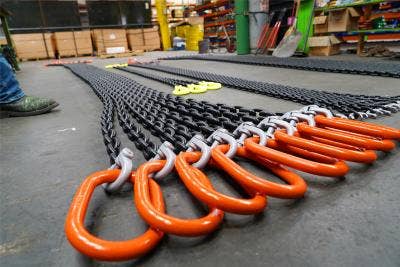
Every rigger is aware of the challenge: a heavy, uneven load that can't be managed by a single-leg sling without risk of tipping or twisting. For these intricate, multi-point lifts, bridle chain slings serve as the engineered solution, providing stability, control, and safety on site.